Adaptations on a 4-Month Clock
Tendons, power, and coordination adapt on a four-month clock — and knowing which gains are slow changes how you plan your training year.
Here is an uncomfortable fact about training after 40: some of the most valuable things you can build in your body take about as long to develop as it takes to grow a baby halfway. Not a week. Not a “six-week shred.” A third of a year, minimum, before the adaptation you’re chasing actually shows up.
This is the part of fitness culture nobody monetizes well, because you cannot sell a four-month timeline as a transformation. There’s no before-and-after photo for “your tendons got slightly springier over the course of a season.” But if you understand the clock, you make much smarter decisions about how to spend your weeks. So let’s talk about the clock.
The slow adaptations are the good ones
When you do something explosive — a jump, a hop, a hard bound off one leg — you’re not really training your muscles the way a set of curls trains your biceps. You’re training a whole system: tendons, the neural wiring that fires your muscles, the coordination that times all of it, and the reflexes that decide how stiff your ankle gets a hundredth of a second before your foot hits the ground.
Those systems improve on long timelines. The research puts tendon adaptation at roughly three to four months. Reducing what physiologists call “neuromuscular inhibition” — essentially your nervous system’s built-in governor that keeps you from producing your full force — takes about four months to meaningfully dial back. These are not quick wins. They are slow, structural rewirings.
And here’s the strategic insight that follows: if the adaptation takes four months, the worst possible way to pursue it is in a discrete four-week “plyometric block” you do once a year and then abandon. You’d be quitting right around the time the tendon was starting to listen.
Why a “block” is the wrong shape
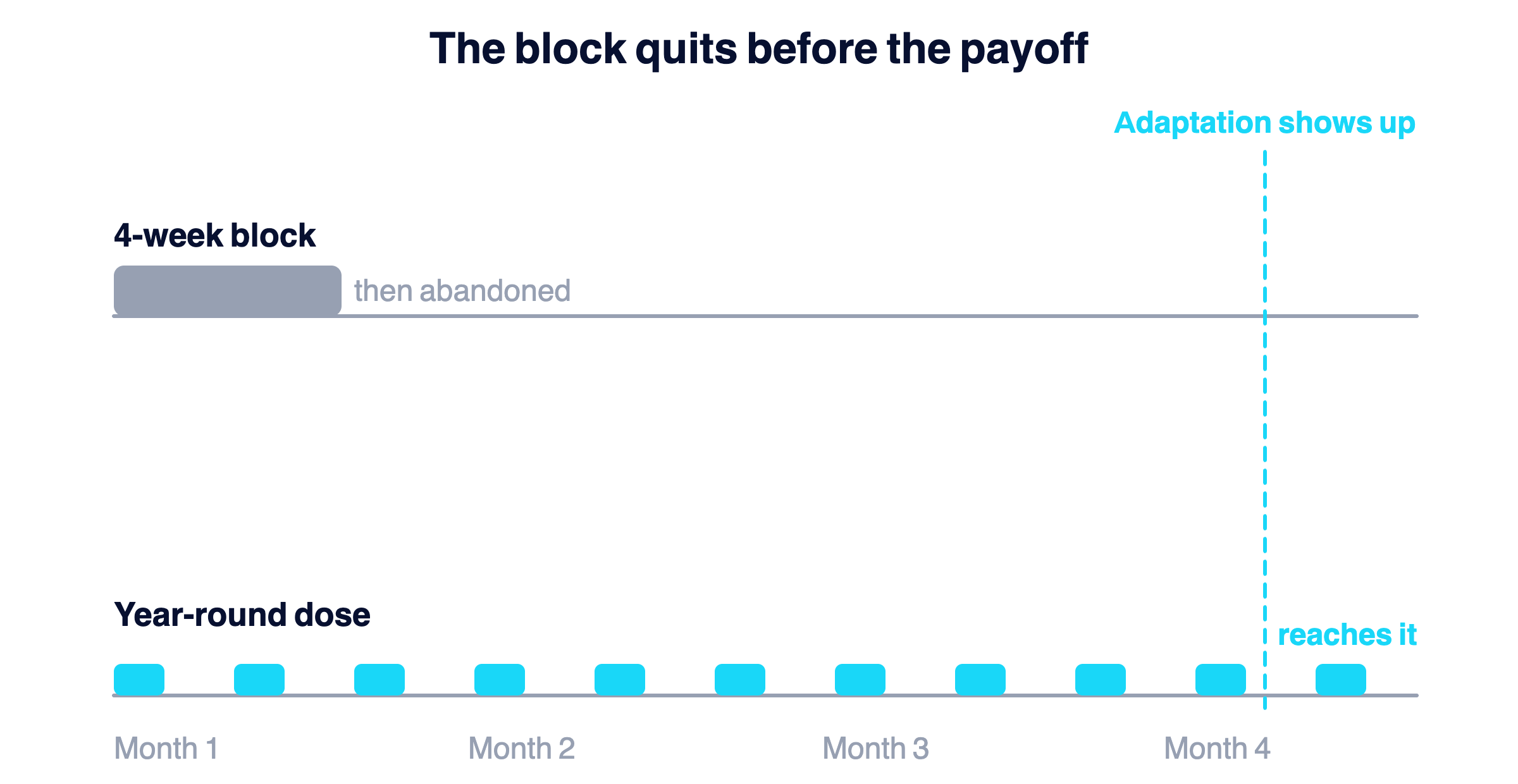
The bodybuilding world trained us all to think in blocks — a month of this, a month of that, a “phase.” That logic works fine for adaptations that respond fast and fatigue fast, like building muscle size, where the limiting factor is metabolic stress and recoverable weekly volume.
But the jumping and reactive qualities don’t work that way. What you’re actually teaching your body is a skill: to anticipate impact, to pre-activate the muscles around a joint before contact, and to stay stiff under load so the tendon can act like a spring instead of a wet rope. Skills are taught by frequent, repeated, low-dose exposure — the way you’d learn a language by speaking a little every day rather than cramming for one intense month.
So the better shape is a small, consistent, year-round dose. A handful of low-intensity pogo hops twice a week, embedded in your warm-up, for months on end, will out-build a heroic two-week jumping binge — and won’t leave you with shin splints, which is precisely what the heroic binge tends to produce.
The trap: respecting the dial, not the rep count
If you do commit to the slow drip, there’s one mistake to avoid, and it’s a sneaky one because it hides behind a number that looks like it’s protecting you: rep count.
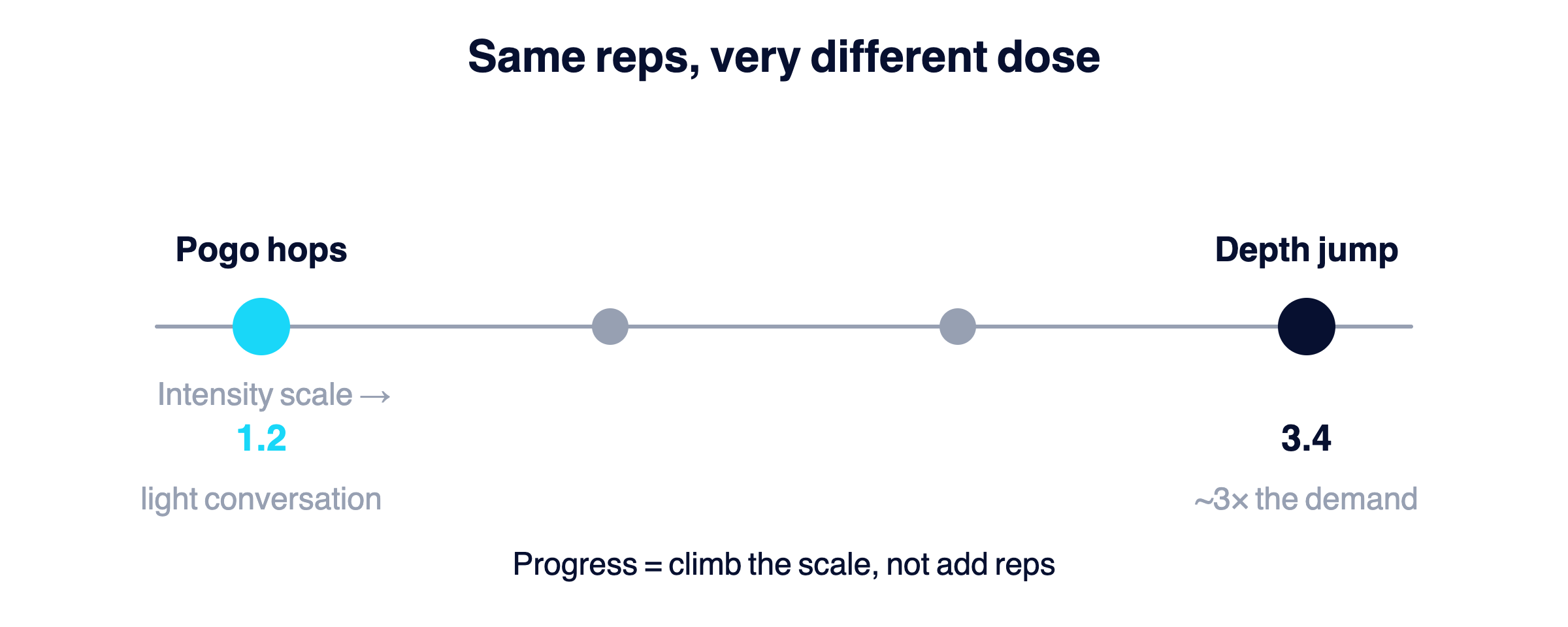
Plyometrics vary enormously in intensity. Researchers have actually ranked them — gentle ankling and pogo hops sit around 1.2 on one weighting scale, while a single-leg depth jump off a 90-centimeter box sits up near 3.4, nearly three times the demand on tendon, joint, and nervous system. So “100 pogos” and “100 bounds” are not the same dose in any meaningful sense, even though the rep counts are identical. One is a light daily conversation with your tendons; the other is a screaming argument.
One more wrinkle worth knowing: short ground-contact hops only pay off if you actually bring momentum into the ground. A bouncy little plate-hop that keeps your feet near the floor looks athletic but barely stresses the spring you’re trying to build. The stimulus lives in the collision, not the choreography.
This matters most when you start feeling good and want to progress. Progress on a plyometric program is not “do more reps.” It’s a careful climb up the intensity scale — and only when the lower rungs have stopped producing soreness or stiffness. The most common cause of cranky Achilles tendons and shin splints in adults isn’t laziness; it’s enthusiasm, expressed as jumping too high too soon.
How to read your own clock
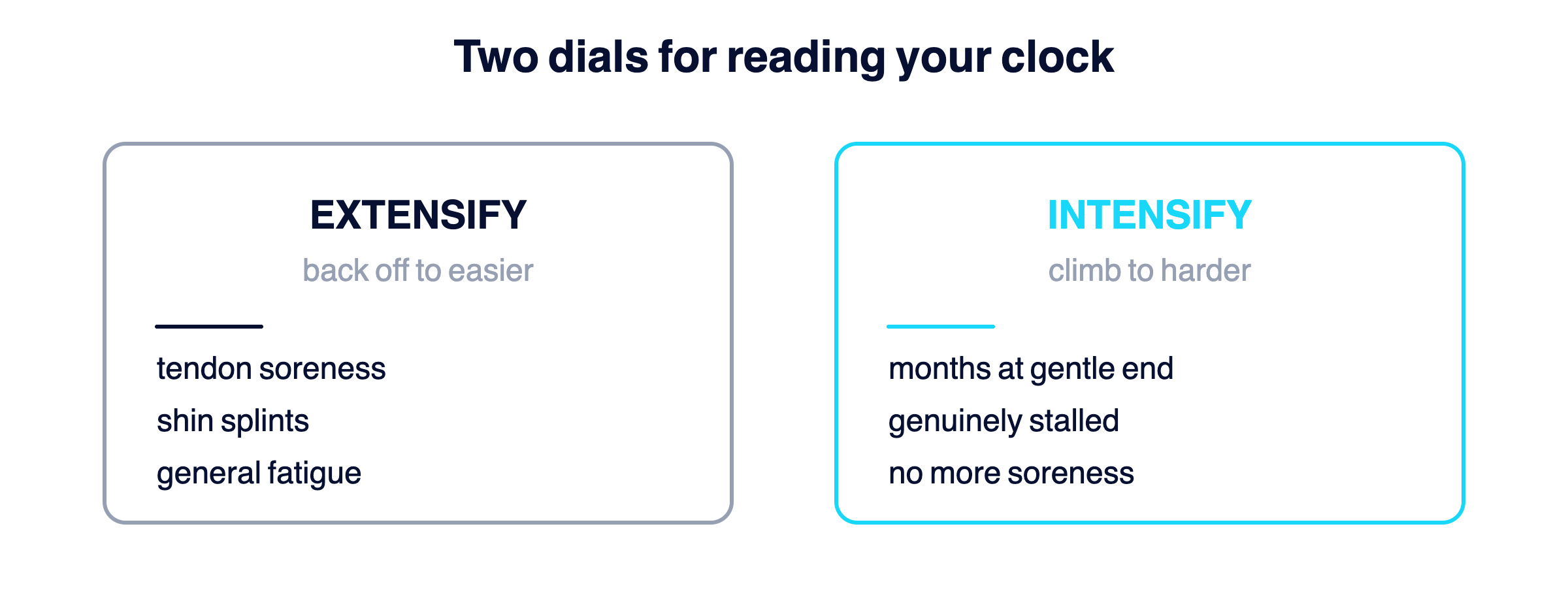
Two dials, then. Extensify — back off to lower-intensity variations — when tendon soreness, shin splints, or general fatigue show up. Intensify — climb to a more demanding variation — when you’ve genuinely stalled because you’ve spent months at the gentle end and your body has stopped being challenged. Let both objective signals (are you jumping higher? is ground contact getting crisper?) and honest subjective readiness guide the dial. Not what feels impressive in the moment.
The reframe we want you to leave with is this: you are not doing workouts that pay off this week. You are making small, repeated deposits into a tendon-and-nervous-system account that compounds over a season. The athletes who stay springy into their 50s and 60s aren’t the ones who jumped the highest in any single month. They’re the ones who never stopped jumping a little.
Set the clock for four months. Then keep it running.