Cardio the Day After Leg Day
Easy Zone 2 cardio the day after a hard lift speeds recovery by tipping your nervous system back toward rest-and-digest — if you keep it genuinely easy.
There’s a certain logic that feels obviously true and turns out to be mostly wrong: the day after a brutal leg session, when your quads scream on the stairs and sitting down is a negotiation, the smart move is to do nothing. Rest. Lie flat. Let the body repair itself in peace. And to be fair, rest is not a bad idea. But it turns out that doing a little bit of easy, gentle cardio the day after hard lifting can actually help you recover faster than doing nothing — and the reason is a nice piece of physiology involving your nervous system.
Here’s the mechanism. Your autonomic nervous system — the part that runs the background processes you don’t consciously control — has two modes. There’s the sympathetic branch, the “fight-or-flight” system that ramps up during stress, hard training, and heavy lifting; and there’s the parasympathetic branch, the “rest-and-digest” system that governs recovery, tissue repair, and calming everything back down. A hard resistance session leaves you tilted toward the sympathetic side, keyed up and inflamed. The goal of recovery is essentially to swing the pendulum back toward parasympathetic dominance. And it happens that low-intensity aerobic work — an easy walk, an unhurried bike ride, a light swim — is a remarkably effective way to nudge that swing. Gentle rhythmic movement increases blood flow, clears metabolic byproducts, and, crucially, triggers a parasympathetic response that active rest simply does better than passive rest.
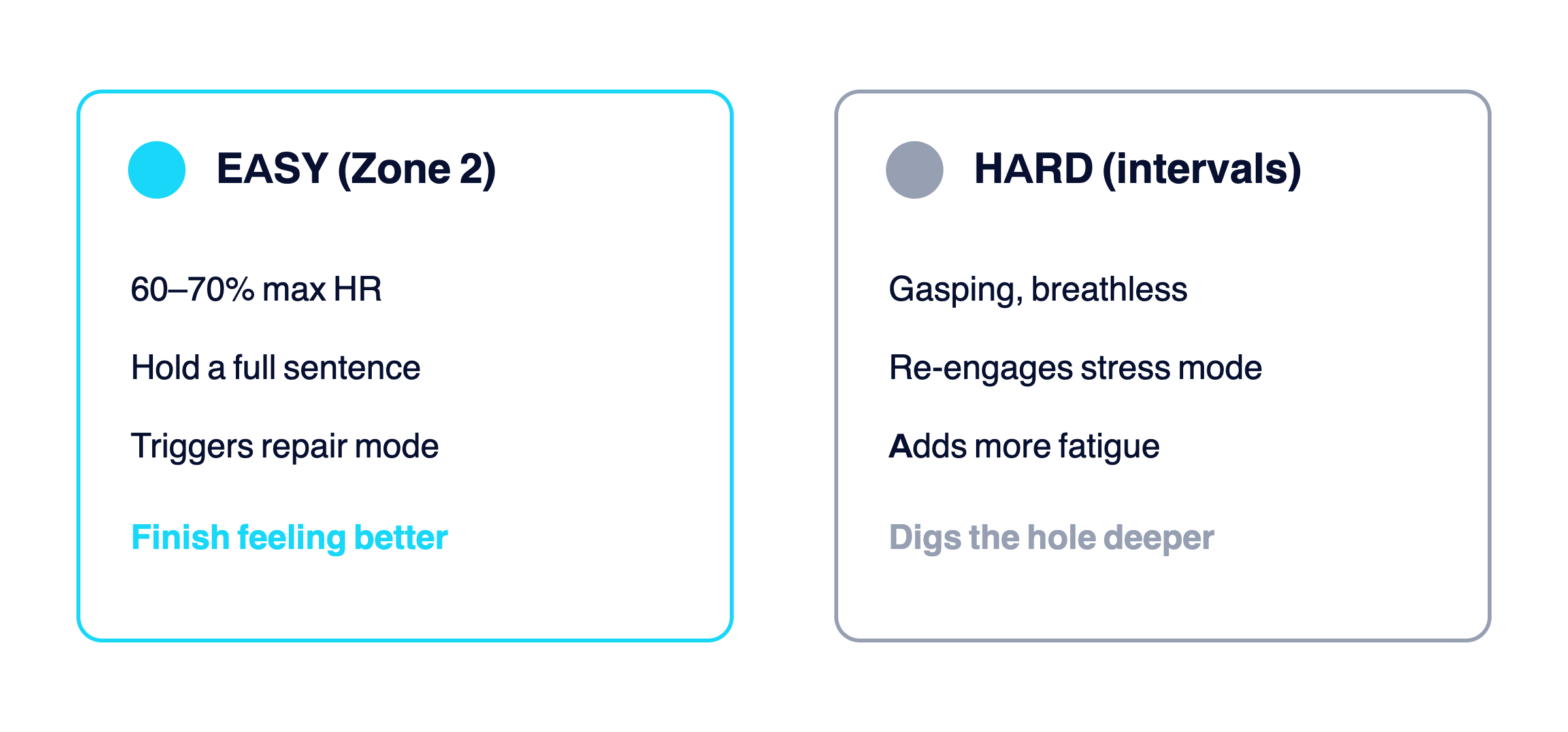
The critical word here is easy. This is not a hidden excuse to sneak in a fitness stimulus. If you turn your recovery ride into an interval session, you defeat the entire purpose: you re-engage the sympathetic system, add more fatigue, and dig the hole deeper. The intensity that produces the recovery benefit is genuinely conversational — the same Zone 2 territory we talk about for building an aerobic base, roughly 60–70% of max heart rate, a pace at which you could hold a full sentence without gasping. If you finish your “recovery” cardio feeling like you accomplished something impressive, you did it wrong. You want to finish feeling better than when you started.
How to actually schedule it
The practical version is simple. On the day after a hard lower-body or full-body lifting session, do 20–40 minutes of easy cyclical aerobic work. Walking is the default and it’s excellent — it loads the sore tissues gently, it’s low-impact, and it’s hard to overdo. Cycling and swimming are great too, and there’s a real argument for picking a modality that isn’t the one that’s sore: if your legs are wrecked from squats, an easy swim or a gentle bike lets you drive blood flow and parasympathetic tone without pounding tender quads through another impact-heavy session.
There is one scheduling wrinkle worth respecting, and it’s the concurrent-training issue. Strength and power adaptations depend on neuromuscular and anaerobic pathways, while endurance work runs on the oxidative system — and when you stack the two too closely, the aerobic work can blunt your strength gains. But notice that this concern applies to hard aerobic work done near hard lifting. Easy recovery cardio the day after lifting doesn’t trip this wire, precisely because it’s low intensity and it’s on a separate day. You’re not competing for the same adaptive resources; you’re using low-grade aerobic movement as a recovery tool, not a training stimulus. The interference effect is a reason to keep your genuinely hard cardio away from your heavy lifting days — not a reason to skip the gentle stuff.
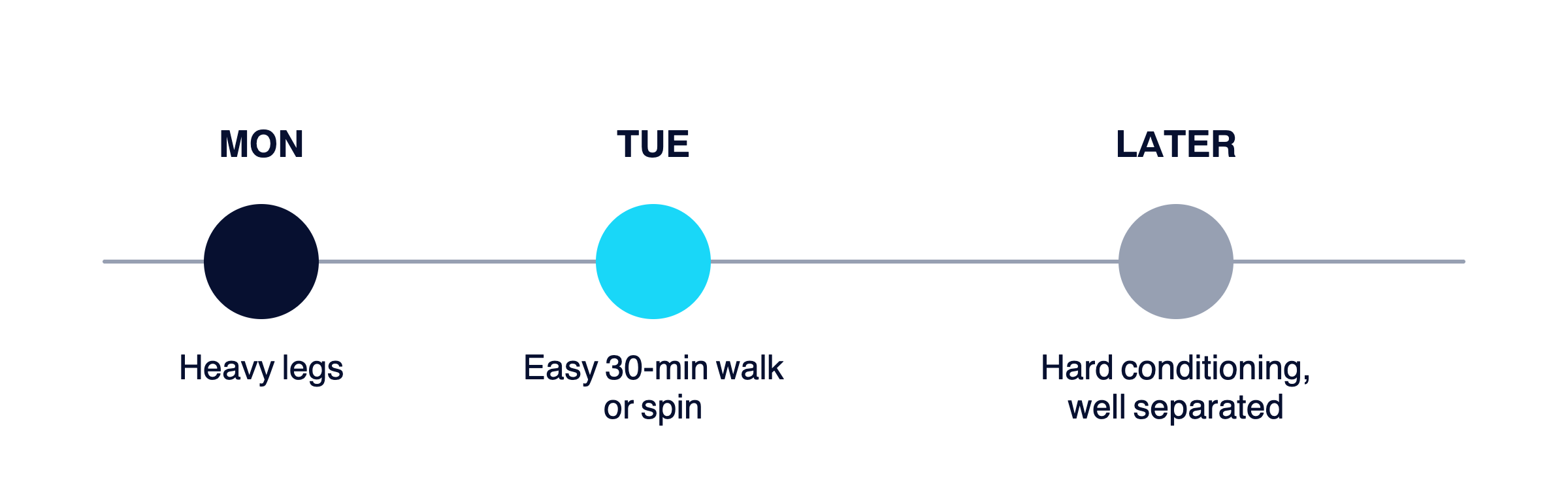
So the weekly picture looks something like this: heavy lower-body work on Monday, easy 30-minute walk or spin on Tuesday, and if you have a genuine hard conditioning session on the calendar, put it on a day well separated from your heaviest lifts (ideally more than four hours apart if it must share a day, with real food in between). The recovery cardio slots in almost invisibly — it doesn’t need to be a workout, it doesn’t need to be tracked, it just needs to be easy and consistent.
The reframe here is the useful part. Most of us file cardio under “fitness stimulus” — the thing you do to get in shape, that leaves you tired. But at low intensity, on the right day, it’s also a recovery instrument, a way to actively coax your nervous system out of stress mode and into repair mode. For adults over 40, whose recovery capacity is worth protecting rather than gambling with, that’s a tool worth using deliberately. Leg day earns you the right to a gentle walk the next morning. Take it.