Double Progression: The Simplest Way to Keep Getting Stronger
TLDR - Double progression means adding reps first, weight second — you climb a rep range at a fixed load, then bump the load and start over. - It solves…
TLDR
- Double progression means adding reps first, weight second — you climb a rep range at a fixed load, then bump the load and start over.
- It solves the two ways people stall: adding weight too fast (form breaks, joints complain) or never adding anything (comfortable, pointless).
- It’s especially good for the 40+ lifter because it builds in a natural readiness check and keeps you away from grinding failure.
- Pick a range (say 6–10), a rep target across your sets, and only load up once you hit the top everywhere.
The problem with “just add weight”
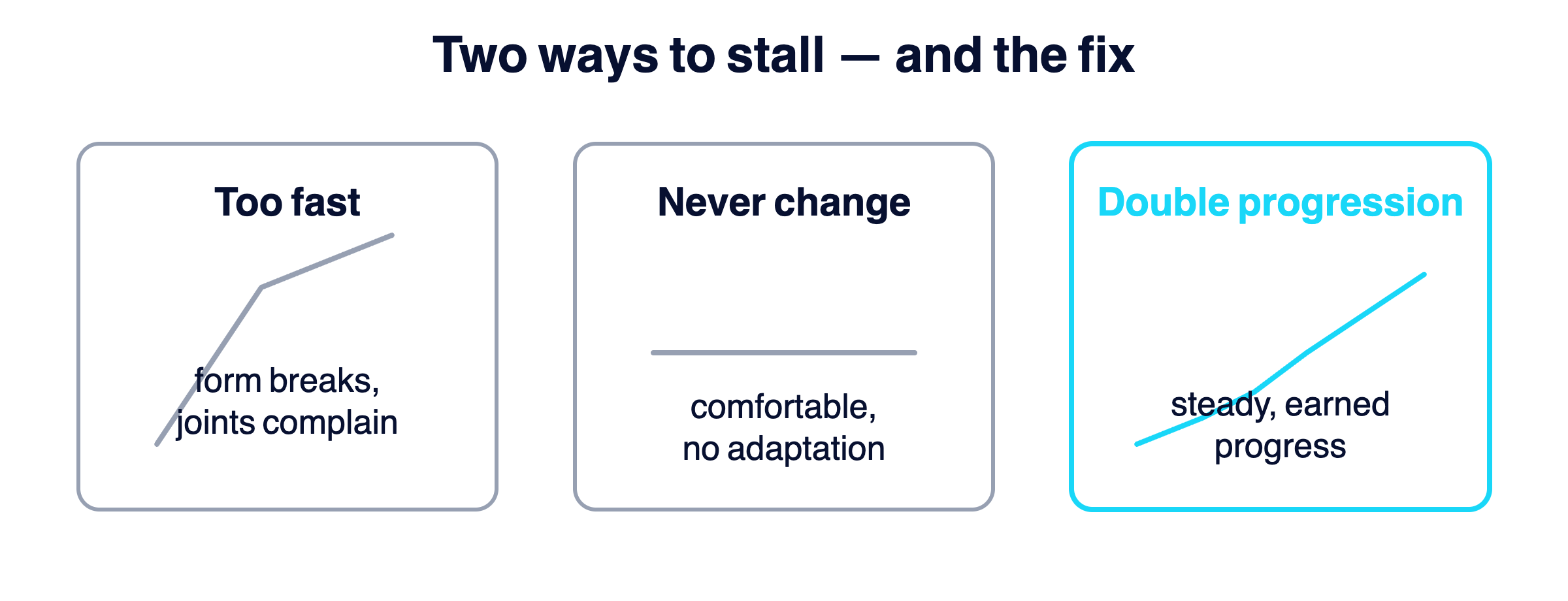
Most people know exactly one way to progress: put more on the bar. This works beautifully for about three weeks, and then it doesn’t. You add five pounds, your form gets a little worse, you add five more, and now your knee has opinions during your morning walk. The linear approach assumes your body improves in tidy weekly increments, which it does — right up until it emphatically does not.
The opposite failure is quieter. You find a weight that feels good, and you just… keep doing it. Three sets of eight with the same dumbbells, week after week, month after month. It feels like training. It even makes you sweat. But your body adapts to the demands you place on it, and if the demand never changes, neither do you. The gym becomes a very expensive way to maintain the status quo.
Double progression is the boring, durable answer to both problems. Instead of one variable (weight), you manipulate two, in order: reps first, then load.
How it actually works
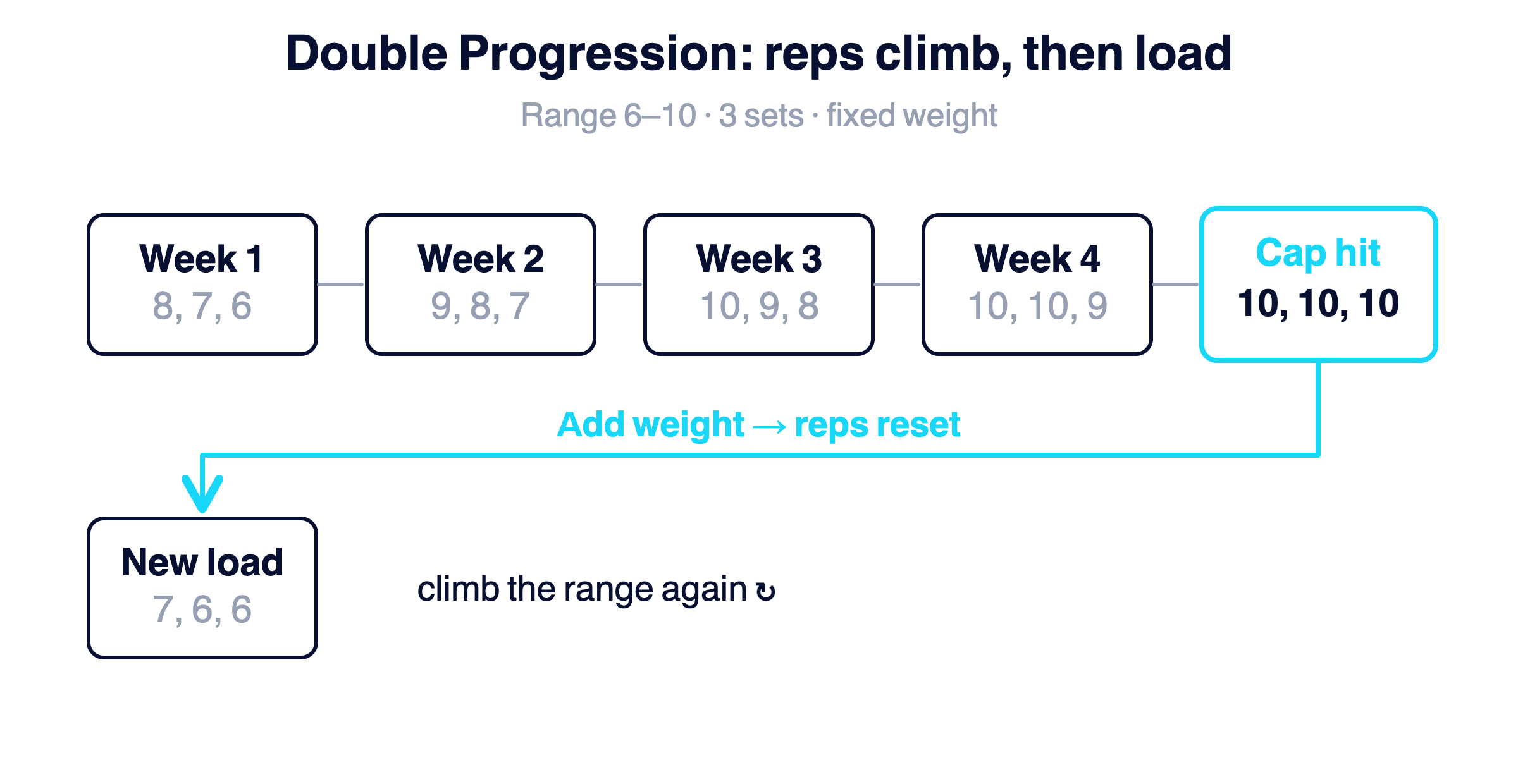
Here’s the whole system. You pick a rep range rather than a single number — let’s say 6 to 10. You pick a weight you can handle for the bottom of that range across all your working sets. Then you chase the top of the range.
Say you’re doing three sets. Week one you might get 8, 7, 6 — you hit the bottom of the range but not the top. Fine. You keep that weight. Next time maybe it’s 9, 8, 7. Then 10, 9, 8. Then 10, 10, 9. The day you hit 10, 10, 10 — the top of the range on every set — you’ve earned the right to add weight. You bump the load, land back around 6–7 reps, and start climbing again.
That’s it. The “double” is that reps go up until they cap out, then weight goes up and reps reset. You’re always progressing on one axis or the other, which means you’re never just spinning your wheels — but you’re also never forcing a load your body hasn’t demonstrated it can handle.
Why this fits the 40+ athlete especially well
Two features make double progression quietly ideal as you age.
First, it’s a built-in readiness check. When you add weight only after completing every rep in the range, the load increase is earned by evidence, not by the calendar. On a bad day, you’ll get fewer reps and simply stay put — no failed grind, no ego-driven max attempt that leaves you sore for a week. Recall that the real cost of heavy work isn’t the effort in the moment; it’s the eccentric damage, the connective-tissue stress, and the recovery tax. Double progression naturally keeps you a rep or two shy of failure most of the time, which is exactly where the stimulus-to-fatigue ratio is best.
Second, it decouples progress from perfect conditions. You don’t need a great night’s sleep and ideal life circumstances to add a rep. Adding reps is a much finer-grained increment than adding weight — the smallest jump on most dumbbells is a 10–20% load increase, which is enormous, whereas adding one rep is a small, absorbable step. This lets you keep the arrow pointing up through the ordinary chaos of adult life.
A few guardrails
Match the rep range to the goal. Lower ranges (say 3–6) with heavier loads bias strength — worth prioritizing if you’re newer or de-trained, because strength is the prerequisite that determines how much force you have to work with in the first place. Higher ranges (8–15) are friendlier for hypertrophy and for joints that prefer a little less load.
One caveat: double progression is a tool for the strength and hypertrophy end of your training. It’s not how you develop power or reactive qualities — those depend on velocity and intent, not on grinding out one more rep. So use double progression to drive your main lifts, and keep your power and plyometric work governed by their own logic. But for the meat-and-potatoes work of getting and staying strong, it’s hard to beat: two dials, one direction, no drama.