You don't have to run to build a heart
TLDR: - Your aerobic engine doesn't care how you build it. Cycling, rucking, and swimming develop the same heart, lungs, and mitochondria as running. -…
TLDR:
- Your aerobic engine doesn’t care how you build it. Cycling, rucking, and swimming develop the same heart, lungs, and mitochondria as running.
- What matters is holding the right intensity (conversational Zone 2), not the modality. Rotating modalities also spreads joint stress and helps you stick with it.
- Sport-specific efficiency still requires time in the actual movement, but cardiovascular fitness is fully portable.
There’s a stubborn belief that “cardio” means running, and that if your knees opted out somewhere around your 45th birthday, you’ve been quietly excused from building endurance. This is a category error. Running is one way to load your cardiovascular system. It is not the system itself. The thing you’re actually training (a bigger stroke volume, denser capillary networks, more mitochondria in the muscle, better fat oxidation) responds to cardiovascular load, not to impact. Any cyclical activity that keeps your heart in the right zone for long enough will build the same engine. Your mitochondria have never once checked whether your feet left the ground.
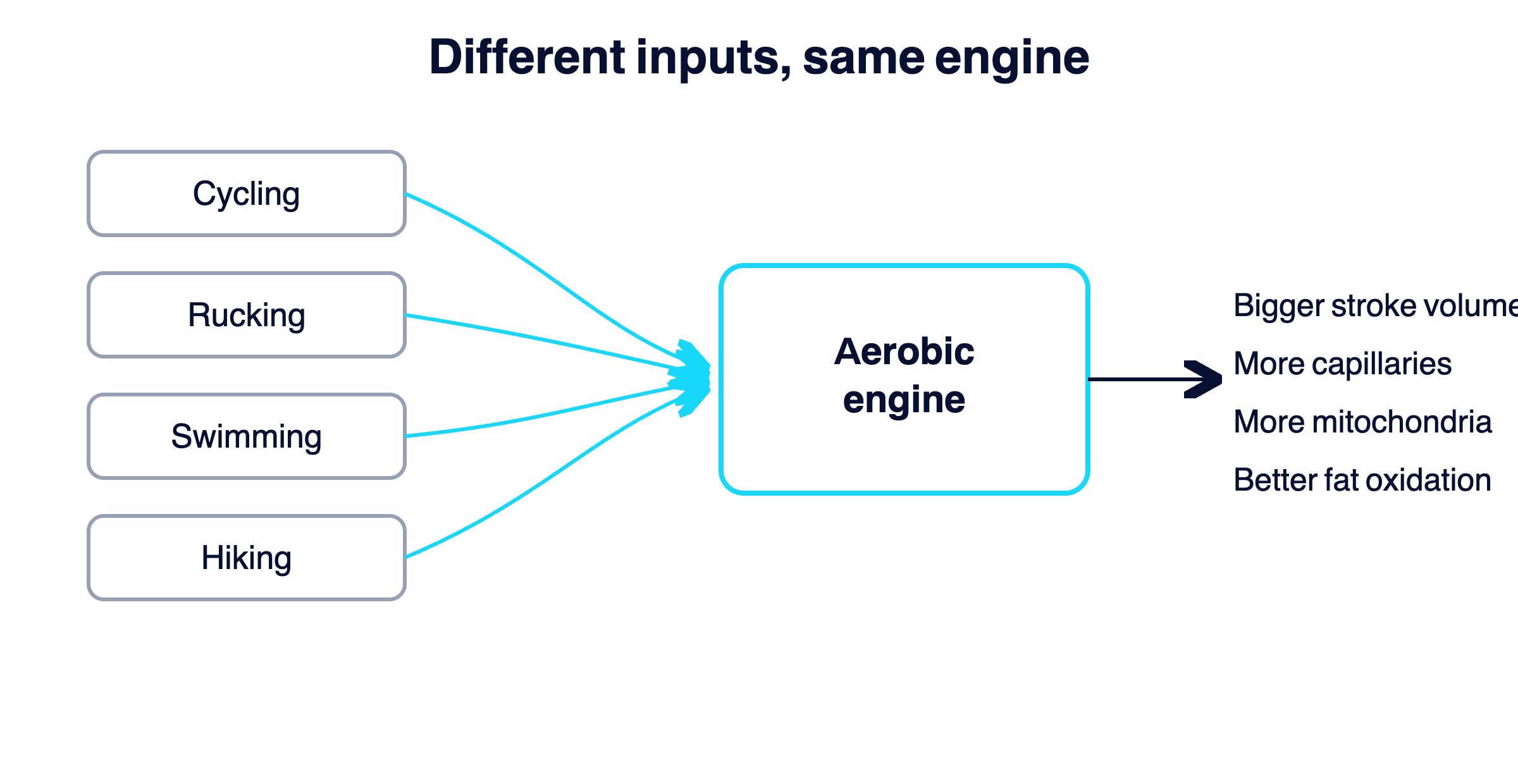
This matters because the adaptations we care about are both central and peripheral. The central ones, a stronger and more efficient heart plus better lung function, are basically agnostic to how you generate the demand. The peripheral ones, the capillaries and mitochondrial machinery inside the working muscle, are more local, so cycling builds them most in your legs and swimming distributes them differently. But for the general goal of building an aerobic base and a durable heart, rucking, cycling, swimming, and hiking are interchangeable. You can build a serious engine having never jogged a step. The one real caveat: if your goal is to be efficient at a specific event, say running a 10k, you eventually need time in that exact movement, because economy is a skill. Fitness and skill are different accounts, and you can fund the fitness one from almost anywhere.
The intensity is the whole game
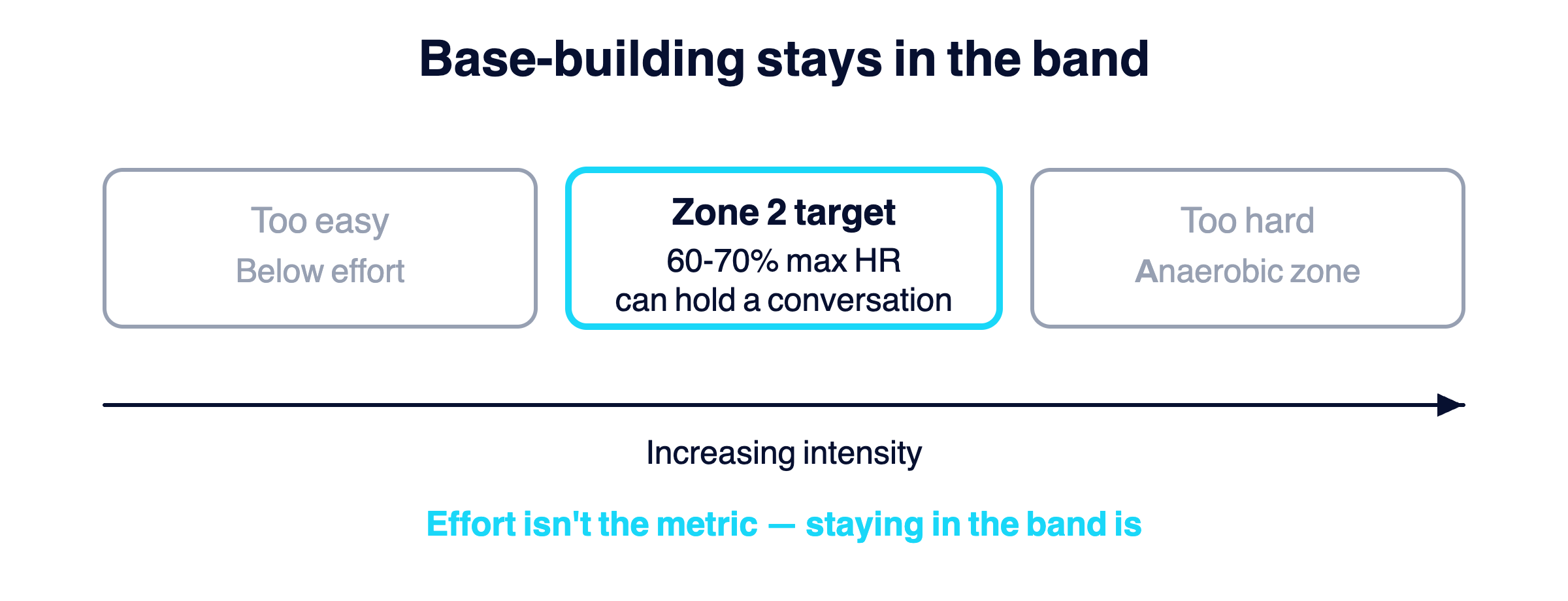
Here’s the part people get wrong regardless of modality: base-building work has to actually stay easy. We’re talking below your first ventilatory threshold, roughly 60 to 70% of max heart rate, a pace where you can hold a conversation. Go harder and you start recruiting anaerobic pathways, which train a different system entirely. So the discipline isn’t in suffering, it’s in restraint. This is counterintuitive for the type-A crowd, but on aerobic days effort is not the metric. Staying in the band is. If you’re a swimmer who can’t help racing the clock, or a deconditioned runner whose heart rate spikes the moment you jog, use intervals: three minutes easy jogging, one minute walking, repeat. That keeps your heart in the target zone while your legs (or lungs) catch up to the demand.
The overlooked advantage of not being wedded to running is that you can rotate. Ruck on Monday, cycle Wednesday, swim Saturday. This spreads mechanical stress across different tissues, so your Achilles and knees don’t absorb every session, which for anyone over 40 is not a minor consideration. Rotating modalities also, boringly but importantly, keeps you doing it. Adherence beats optimization over a year, and the aerobic adaptations you want accrue from consistent weekly volume, not from heroic single efforts. Spreading the same total time across several sessions produces better adaptation than cramming it into one long Sunday death march.
Fit it around the lifting
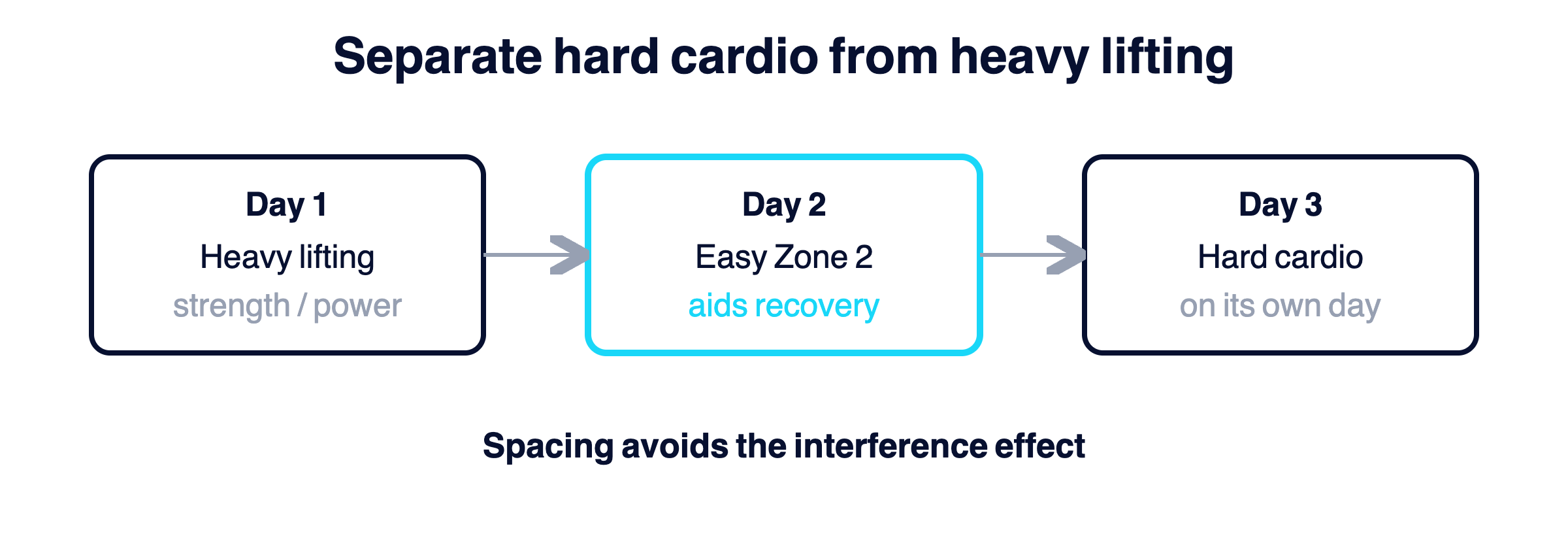
One practical note for those of us also trying to stay strong: aerobic and strength adaptations pull in slightly different directions. Endurance runs on oxidative pathways; strength and power run on neuromuscular and anaerobic ones. Do a lot of hard cardio right on top of heavy lifting and you can blunt the strength gains, the so-called interference effect. The fix is simple scheduling: put aerobic work on separate days from heavy lifting, or at least separate the two by four-plus hours with a real meal in between.
And here’s a bonus that reframes cardio entirely. Easy aerobic work the day after a hard lifting session actually speeds recovery. A gentle spin or a flat ruck drives a parasympathetic, rest-and-digest response that helps you bounce back. So your Zone 2 session isn’t only building an engine; on the right day it’s a recovery tool. Low-intensity, low-impact, joint-friendly, and doing double duty. You don’t have to run to build a heart, and once you stop insisting on it, you’ll find a lot more ways to keep building one for the next forty years.