The single-leg hop: your most honest self-test
TLDR: - Hop and land on one leg, then the other. A gap of more than 10% between sides is a signal worth investigating, not ignoring. - Watch how you land…
TLDR:
- Hop and land on one leg, then the other. A gap of more than 10% between sides is a signal worth investigating, not ignoring.
- Watch how you land: bending at the ankle and knee is good, collapsing sideways at the hip means your knee isn’t doing its job.
- Sharp, pinpoint pain on the inside of the shin is a red flag. Stop and get it looked at.
Picture the last time you caught your foot on a curb, a tree root, or the lip of a rug. There’s a half-second where one leg has to do everything: absorb your falling weight, keep your hip from buckling, and shove you back upright before your face meets the pavement. You either had that half-second of reserve or you didn’t. Most of us don’t find out which until it’s happening, and by then it’s a bit late to train for it.
The good news is you can find out on purpose, in your living room, in about thirty seconds, with no equipment. Stand on one leg and do a small hop, up and down, landing on the same leg. Then do the other side. That’s it. This unglamorous little test is one of the most honest things you can do after 40, because a single-leg hop exposes problems a two-legged jump politely hides. When both legs work together, the strong side quietly covers for the weak one, and you never notice the difference. Take one leg away and the truth comes out.
There are three things to watch for, and none of them require a stopwatch or a lab. The first is asymmetry, a real gap between your legs. If you can hop comfortably and in control on your right but your left feels wobbly, weak, or just less, that’s a side-to-side difference worth taking seriously. The rough rule coaches use is that a gap bigger than about 10% between legs is a signal to investigate. This matters especially if you’ve ever had an ankle sprain or knee tweak that “healed.” After a lower-limb injury, the thigh muscle on that side often shuts down and stays quiet for months, long after the pain is gone, so a leg that feels fine can still be absorbing force poorly. The hop tells you whether it’s actually back.
The second thing to watch is how you land, and this is the part most people get wrong without realizing it. When you come down, you should absorb the impact by bending at the ankle and knee, folding forward and back, like a spring compressing. The cheat is to instead drop and buckle sideways at the hip, letting your knee cave in or your torso tip over. It can look almost graceful. It isn’t. That sideways collapse means your knee isn’t taking the load it’s supposed to, and it quietly limits everything downstream: how well you accelerate, jump, catch yourself, or change direction. The one technical idea worth knowing here is what a good landing is actually doing. Your muscles are working as brakes, lengthening under load to slow you down (this is called absorbing force, and it’s a different, harder skill than pushing off). Lots of people can push off fine but land like a folding chair.
The third thing is the simplest: pay attention to sharp, pinpoint pain on the inside of your lower shin, the bone itself, not the muscle. That’s not ordinary soreness. It’s a red flag for a bone stress injury, and the right response is to stop, not push through, and get it assessed. Dull, spread-out muscle fatigue is fine. A specific spot on the bone that lights up when you hop is not.
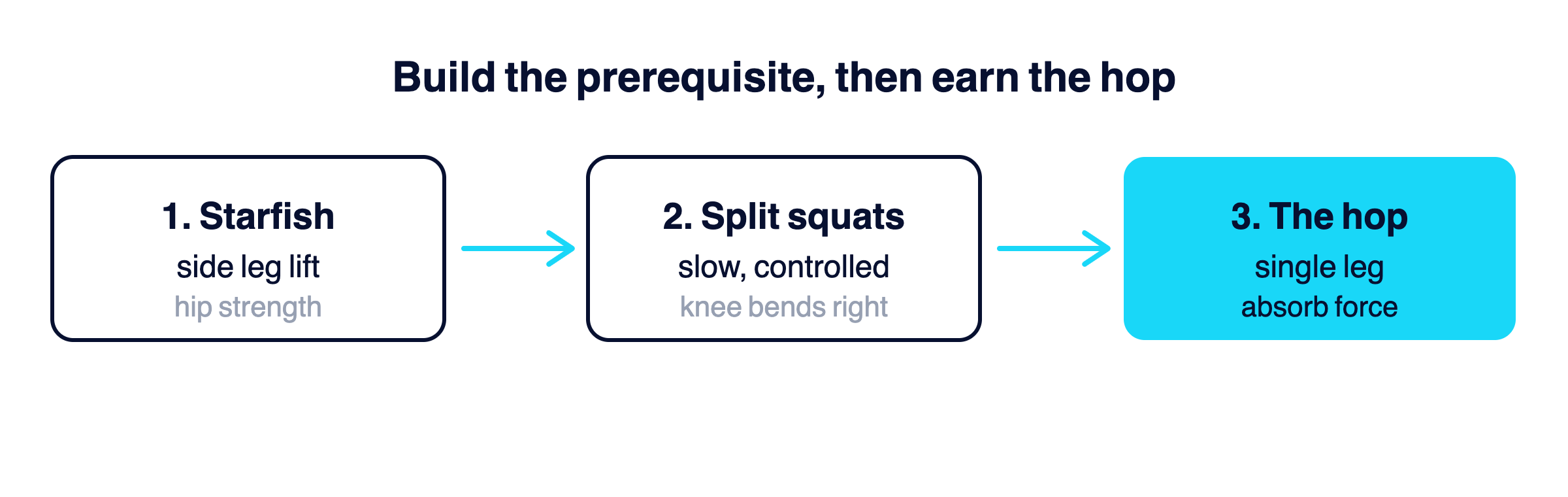
So you ran the test and something looked off. Now what? If the problem is sideways collapse at the hip, the fix isn’t more hopping, it’s teaching the knee to bend properly first. Deep split squats and slow, controlled squats where you deliberately move front-to-back retrain the knee to absorb force the right way. And if a full hop feels like too much right now, you don’t need it yet: a starfish side-lying leg lift (lying on your side, holding your top leg raised, working toward a 30-second hold) builds the lateral hip strength that makes landings safe in the first place. Build the prerequisite, then earn the hop.
The reason any of this is worth thirty seconds of your week is that the half-second on the curb is coming, whether you’ve trained for it or not. A hop is just that moment, rehearsed on your terms, where the only thing at stake is what you learn.