Prime before you lift
TLDR: - A few short, hard pushes early in a workout can make your jumps and lifts noticeably stronger for the next hour. It's called potentiation. - Try 4…
TLDR:
- A few short, hard pushes early in a workout can make your jumps and lifts noticeably stronger for the next hour. It’s called potentiation.
- Try 4 sets of 3 reps of 3-second all-out pushes against something immovable, before your real training begins.
- It costs almost no fatigue, so you get a warmer, faster nervous system without paying for it later.
Here’s a thing that happens on a good day. You walk into the gym, your first working set feels heavy and sluggish, and then, three or four sets in, the bar suddenly moves faster and lighter than it did at the start. You didn’t get stronger in twenty minutes. Your nervous system just finally woke up. The frustrating part is that by the time it does, you’re already tired from the sets it took to get there.
What if you could wake it up on purpose, in about four minutes, before the work that matters?
The trick: a short, hard push that leaves no mark
The tool is an overcoming isometric, which is a fancy name for pushing as hard as you can against something that won’t move. Press up into a loaded bar you can’t budge, drive against a set of safety pins, or shove against an immovable wall. Nothing travels. Your muscles fire at full effort, but because nothing moves, there’s no up-and-down and no lengthening under load, so almost none of the muscle damage that makes you sore or slow later.
That last part is the whole point. Most ways of making yourself feel stronger, like extra warm-up sets or heavier singles, cost you something. This one is nearly free. You get a big signal to the nervous system with a tiny fatigue bill.
Why does a hard push you couldn’t even see make the next thing feel better? Because how much force you can produce quickly depends less on your muscle size and more on how fast your nervous system can recruit and fire the muscle: how many motor units it switches on, and how rapidly. A brief maximal effort is like revving the engine before you pull out. For a window of several minutes afterward, everything is dialed up. The recruitment is faster, the firing is quicker, and the jump or lift that follows borrows that readiness. Studies have measured jump height improving by up to roughly 7% after a primer like this. Same body, same legs, just a nervous system that showed up on time.
The prescription: 4 x 3 x 3
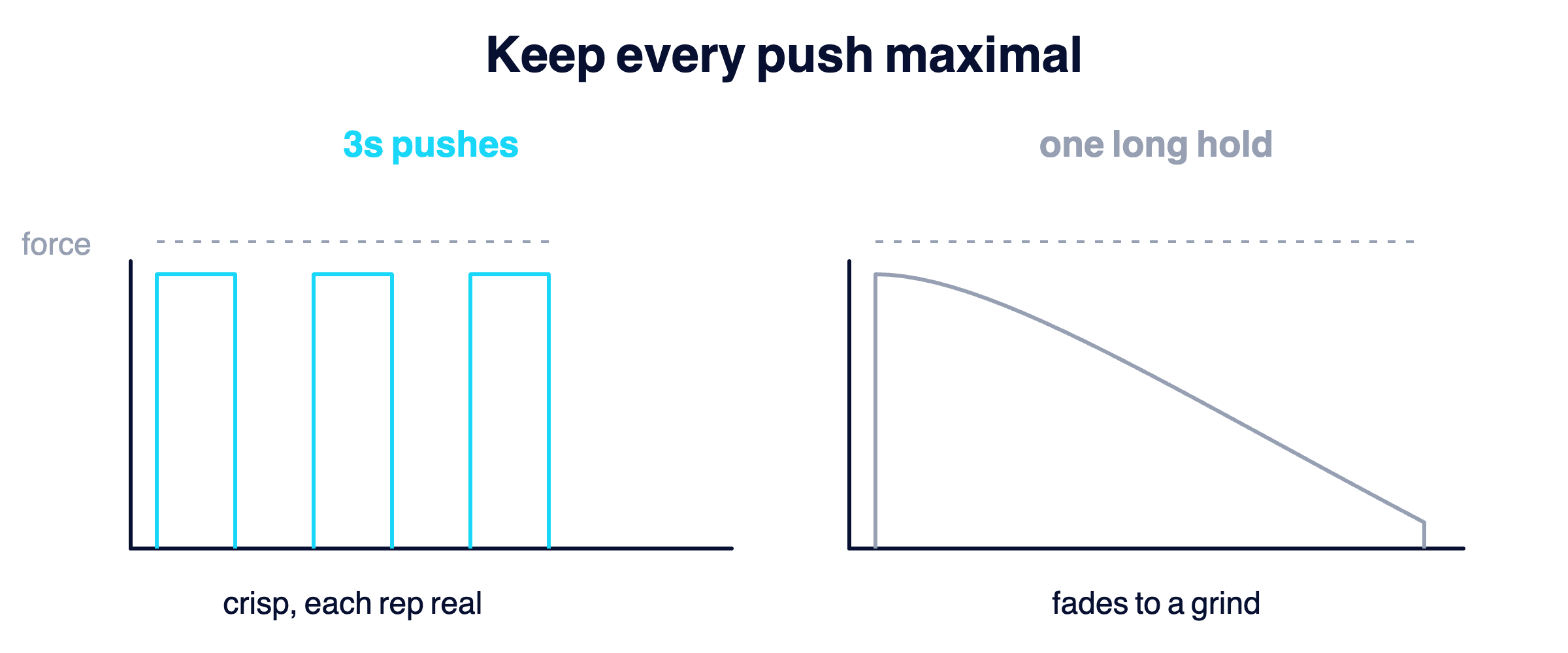
Here’s the version to try this week. Four sets of three reps, each rep a 3-second all-out push. Rest a minute or so between sets.
Why 3 seconds? Because you can only hold a truly maximal effort for about that long before it stops being maximal and starts being a grind. Short pushes let every rep be a real one. Why three reps and four sets instead of one long heroic hold? Same logic. Several crisp near-maximal efforts give you more high-quality output and less fatigue than one long strained one. Think of it as leaving a rep in reserve every time: hard, but never to the ragged edge.
Pick a push that matches what’s coming. If you’re squatting, push up into a bar set on pins at a squat-ish height, or press against a belt anchored under your feet. If you’re about to jump, an isometric leg drive fits. The rule is simple: prime the pattern you’re about to train, because the readiness goes where you point it.
Where it goes in the session
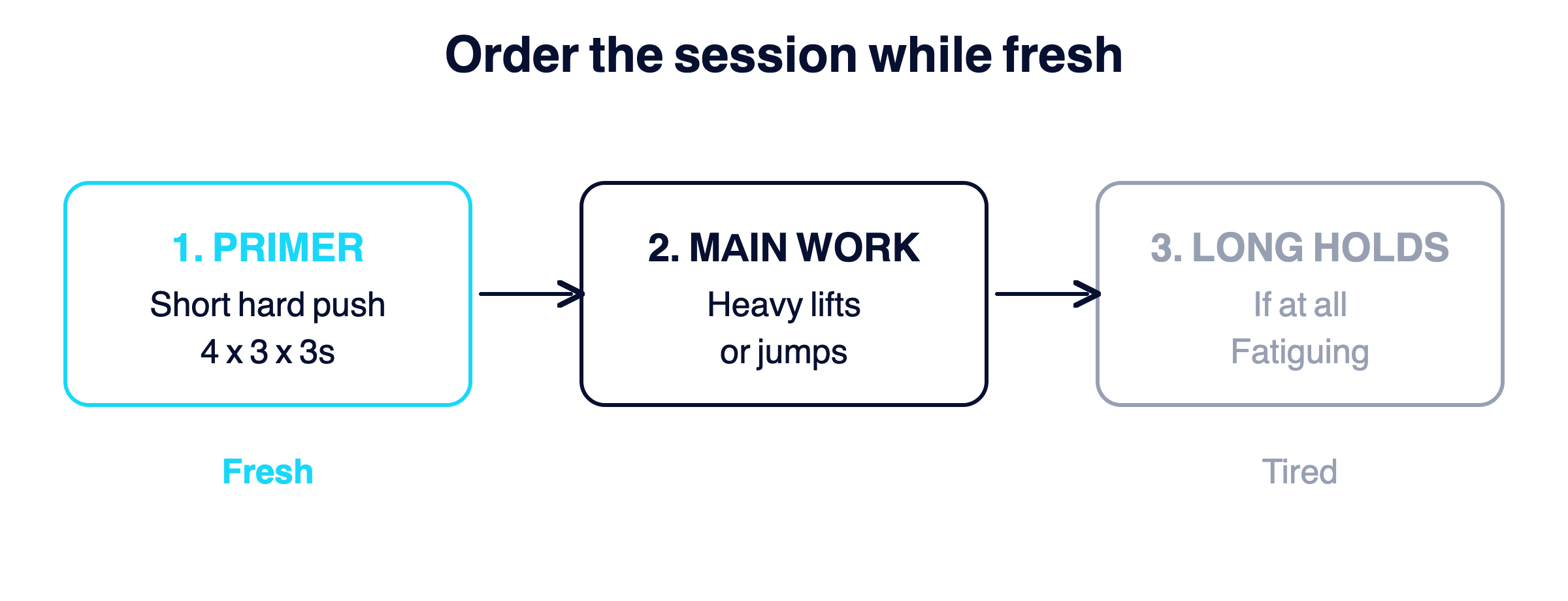
Order matters, and it runs opposite to how a lot of people warm up. Do this first, while you’re fresh. That’s when a primer can actually lift your output on the work that follows. Then do your main lifts or jumps. Save any long, grinding holds for the very end, if you do them at all, because those create fatigue rather than clearing it.
A quick note on who this is for. If you’re newer to training, or you’ve had time off, don’t lead with maximal pushing. Build some general capacity first with longer, easier holds. The primer is a performance tool, and it works best once you already have something to prime. But if you’ve got some training miles on you and you’re staring down a heavy day or a jump session, wondering why the first twenty minutes always feel like moving through wet cement, this is your fix. Four minutes, no soreness tax, a nervous system that shows up early.
Try it Monday. Notice what your second exercise feels like.